
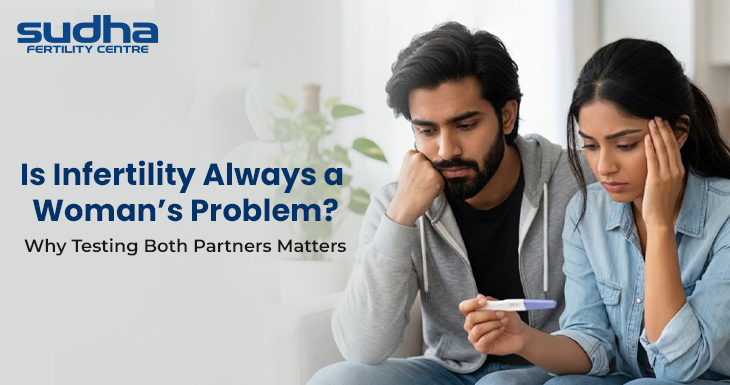
Is Infertility Always a Woman’s Problem? Why Testing Both Partners Matters
When a couple cannot conceive, fertility evaluation often focuses on the woman. She undergoes multiple tests, takes medications, and carries the emotional weight of the diagnosis. Yet in nearly half of all infertility cases, the husband is the cause or part of the cause. The medical data is clear and unambiguous: infertility is not always a woman’s problem. Studies reveal that about 40 to 50 percent of infertility cases in India have a male factor. This article explains what male factor infertility is, why both partners should be tested together at the start, and why this matters for getting the right diagnosis quickly.
What the Actual Numbers Show
Here is the distribution of infertility causes based on Indian data from the Indian Society for Assisted Reproduction (ISAR) and major fertility centres across the country.
|
Infertility Factor |
% of Cases |
What It Includes |
|
Female factor only |
30–40% |
Ovulation problems (PCOS, thyroid, hormonal), fallopian tube damage (PID, endometriosis), uterine factors (fibroids), egg quality decline |
|
Male factor only |
30–40% |
Low sperm count, poor motility or shape, azoospermia (no sperm), varicocele, hormonal imbalance, sperm DNA damage, food and lifestyle factors |
|
Both partners |
20–30% |
Combined factors where both contribute. Common pattern: mild male factor plus female ovulation issue |
|
Unexplained |
10–20% |
All standard tests are normal, but a couple of them cannot conceive. Treatable through lifestyle, IUI, or IVF |
In any couple struggling to conceive, there is roughly an equal chance the issue is the husband’s, the wife’s, both, or neither. The assumption that infertility is mainly a woman’s issue is not supported by medical evidence. Male factor and female factor each account for roughly equal shares of infertility diagnoses.
Why Male Factor Is Often Overlooked
Several reasons explain why male infertility may go undiagnosed or untested in couples seeking fertility evaluation.
First, the Biological Aspect: pregnancy and birth occur in the woman’s body, so the assumption that fertility resides with her follows logically, though the biology is more complex.
Second, Clinical Practice: historically, doctors have focused on female evaluation first. This bias is changing, but many fertility clinics still test the wife extensively before ordering a semen analysis.
Third, Psychological Factors: male infertility can feel emotionally threatening for many men, leading to avoidance and reluctance to be tested.
Fourth, Lack of Awareness: male infertility often has no symptoms, and many men believe that if they feel healthy and have normal sexual function, their fertility must be intact.
The clinical consequence of missing the male factor is significant. Women undergo unnecessary tests and treatments. Time passes. The actual problem remains unaddressed. Couples waste resources and emotional energy on treatments aimed at the wrong partner.
What Is Male Factor Infertility?
Male factor infertility means a problem with the production, function, or delivery of sperm. The main causes include low sperm count (oligospermia), poor sperm motility, abnormal sperm morphology, azoospermia (no sperm in semen), sperm DNA damage, hormonal imbalances, varicocele (enlarged scrotal veins), lifestyle factors such as smoking, diabetes, obesity, genetic conditions, past infections, and trauma or surgery to the reproductive area. Research states that 10 – 15% Of Indian couples are affected by infertility; in 2 out of 5 cases, the issue is at least partly male.
A critical fact: Male factor infertility is often silent. A man can have low testosterone, low sperm count, poor motility, abnormal morphology, or no sperm in his semen while feeling completely healthy. Sex drive is normal. Erections are normal. Energy levels are normal. There is no pain or visible sign. The only way to know is a semen analysis, a simple, non-invasive test that takes one visit.
Common Myths about Male Infertility
Several misconceptions about male infertility persist despite clear medical evidence to the contrary.
|
Myth |
Reality |
| If a man is healthy and active, he is fertile. | Many infertile men are otherwise healthy. Sperm quality is not visible from the outside. Only semen analysis can confirm. |
| If he has fathered a child before, the issue must be hers. | Sperm quality changes with age and lifestyle. A man who fathered a child years ago may have current issues. |
| Only older men have fertility problems. | Male factor infertility affects men in their 20s, 30s, and 40s. Lifestyle factors contribute across all age groups. |
| Strong intimate drive means good fertility. | Sex drive is driven by testosterone and emotional state. Sperm quality is a separate biological issue. |
| Semen analysis is invasive or shameful. | It is non-invasive, private, takes one visit, and produces results within hours. |
| If the husband is infertile, the couple cannot have children. | Most male factor infertility is treatable. ICSI, IUI, and other advanced treatments help most couples conceive. |
| Once diagnosed, a man’s fertility cannot improve. | Many causes are reversible. Lifestyle changes, surgery, and medications can improve sperm parameters within 3 months. |
| If the wife is fertile and healthy, pregnancy will happen. | Conception requires both healthy sperm and healthy eggs. A fertile woman cannot conceive without functional sperm. |
Why Both Partners Must Be Tested at the Start
When a couple cannot conceive, both partners should be evaluated at the same time. Not the wife first while the husband waits. Not sequentially over months. Both at the initial consultation.
This simultaneous approach matters for several reasons. Time is critical. In many cases, couples spend 1 to 2 years in fertility evaluation focused only on the wife, while the actual issue is the husband. This is biological time lost, especially for women over 35, where age affects egg quality. Cost is another factor. Testing both at the start is cheaper than sequential testing because it avoids unnecessary tests for the wife. Clinical accuracy is also essential. In 20 to 30 percent of cases, both partners contribute to infertility. Testing only one partner misses the combined factors.
The minimum first workup for both: for the wife, ovarian reserve (AMH), thyroid function (TSH), pelvic ultrasound, and fallopian tube assessment (HSG). For the husband, semen analysis is the single most important male fertility test. Both evaluations can typically be completed at the first specialist visit.
Understanding the Testing Process
A comprehensive fertility evaluation for both partners involves specific, well-established diagnostic tests that provide clear information about reproductive health and function. The tests together create a complete picture of female reproductive anatomy and hormonal status.
For the male partner, semen analysis is the primary diagnostic tool. A normal semen analysis does not guarantee fertility, just as abnormal results do not guarantee infertility, but it provides essential information about sperm function. If the initial semen analysis shows abnormalities, additional testing may include hormonal evaluation to assess testosterone, FSH, and LH levels, or specialised tests such as sperm DNA fragmentation assessment if indicated by clinical findings.
The timing of these tests matters. Female hormone testing should ideally occur on specific days of the menstrual cycle to ensure accuracy. Male semen analysis requires a period of abstinence before collection, typically 2 to 3 days, to allow adequate sperm accumulation. A fertility specialist coordinates all testing so that results are available together, allowing for a comprehensive discussion of findings and next steps.
The Role of Interpretation
Test results require clinical interpretation in context. A single abnormal result does not determine the treatment path. For example, a low sperm count might be temporary and reversible with lifestyle modifications, or it might reflect a chronic condition requiring assisted reproduction. Similarly, borderline results in female testing need to be interpreted alongside the woman’s age, medical history, and how long the couple has been trying to conceive. A 32-year-old woman with slightly low AMH has a very different clinical picture from a 42-year-old with the same result.
This is why a comprehensive evaluation of both partners simultaneously is so valuable. When a fertility specialist reviews all results together, patterns emerge. A couple might have mild male factor plus mild female factor that individually might be overlooked, but combined explain the difficulty conceiving. Or one partner might have a clear, treatable issue while the other is completely normal. The complete picture guides the treatment strategy.
Moving Beyond Testing
Testing is not the endpoint; it is the foundation for treatment planning. Once both partners have been fully evaluated, the fertility specialist can discuss what the results mean, what options exist, and what approach is most likely to succeed given the specific circumstances. Some couples will benefit from lifestyle modifications and timed intercourse. Others will need assisted reproductive techniques. The key is that the recommendation is based on an accurate diagnosis rather than assumption or incomplete information.
When both partners are tested from the start, couples receive answers quickly rather than spending months or years pursuing treatments based on incomplete information. This efficiency matters not just for time and resources, but for emotional well-being. Couples who understand what is actually preventing conception can move forward with confidence in their treatment plan.
How Sudha Fertility Centre Approaches Couples Testing
At Sudha Fertility Centre, both partners are evaluated together as part of the standard comprehensive fertility workup. Semen analysis is recommended for all male partners from the initial consultation, not as an afterthought or only if the female evaluation reveals no cause.
The approach is straightforwardly clinical and practical. Semen analysis is presented as a routine diagnostic test, the same way female hormone testing and ultrasound are discussed. The test is non-invasive, requires one visit, and produces results within hours. Testing both partners simultaneously at the first visit is more efficient and cost-effective than sequential evaluation over multiple months.
When hesitation arises, the Sudha team addresses it directly. Many men are reassured when a fertility specialist explains that male factor infertility is common, affects approximately 40 to 50 percent of couples, and is highly treatable. A fertility specialist can speak with the partner if needed, addressing concerns and building confidence in the evaluation process. The goal is to move both partners forward with an accurate diagnosis so treatment can begin promptly.
This approach ensures that no time is wasted and that the couple receives a complete picture of their fertility status.
Treatment Options for Male Factor Infertility
Most male factor infertility is treatable. Treatment approaches depend on the specific cause and severity.
- Lifestyle modifications: Smoking cessation, alcohol reduction, weight management, reduced occupational heat exposure, and treatment of underlying conditions like diabetes. Effects appear in semen parameters after 3 months.
- Medications: Hormone replacement for hormonal deficiency, antibiotics for infection, medications for varicocele management.
- Varicocelectomy: Surgical correction of enlarged scrotal veins. Often significantly improves sperm count and function.
- Intrauterine insemination (IUI): For mild male factor, sperm is processed, concentrated, and placed directly in the uterus.
- In vitro fertilization (IVF): For moderate male factor, eggs and sperm are combined in the laboratory.
- Intracytoplasmic sperm injection (ICSI): A single sperm is injected directly into an egg. Standard treatment for severe male factor, including low count, poor motility, and previous IVF failure.
- Surgical sperm retrieval: For men with no sperm in their ejaculate, sperm can often be extracted directly from testicular tissue for use in IVF or ICSI.
With these treatment options, most couples with male factor infertility can achieve pregnancy.
Moving Forward
Infertility is a shared biological reality affecting both partners. Medical evidence clearly shows that male factor and female factor are equally common causes. Both partners should be evaluated simultaneously to establish an accurate diagnosis efficiently.
At Sudha Fertility Centre, both partners are evaluated as part of the standard comprehensive workup. The team addresses all factors affecting fertility and develops treatment plans based on accurate diagnosis. Book a consultation at any of the centres in Bangalore, Hyderabad, Chennai, Coimbatore, and Erode.
Disclaimer: This article is for general informational purposes only and does not constitute medical advice. Male and female infertility evaluation must be individualised based on a complete workup, personal history, and clinical assessment. Always consult qualified fertility specialists for diagnosis and treatment recommendations specific to your situation.

Dr. S. Pradeepa is a fertility specialist at Sudha Fertility Centre, Erode, with expertise in IVF, IUI, ICSI, PCOS, and endometriosis. She holds MBBS, DGO, DNB (OG), and a Fellowship in Reproductive Medicine. Known for her patient-centric approach, she provides personalized, evidence-based care and reviews medical content to guide informed fertility decisions.