
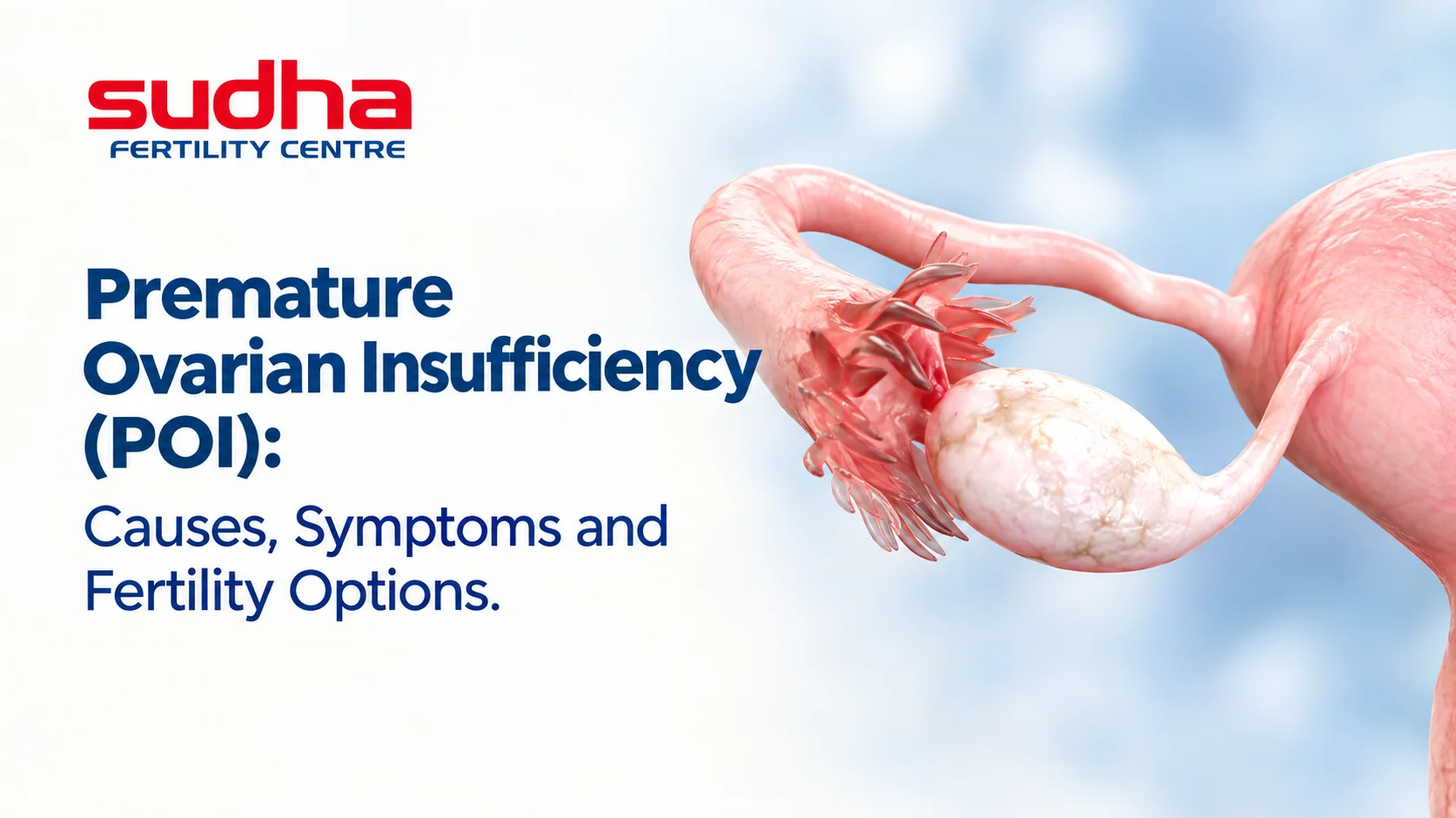
Premature Ovarian Insufficiency (POI): Causes, Symptoms and Fertility Options
Medically Reviewed
Written By: Dr. S. Pradeepa Sudhakar, MBBS, DGO | Senior Fertility Specialist & Vice President, Sudha Fertility Centre
Medically Reviewed By: Dr. S. Dhanabagyam, MBBS, DGO | Founder-President & Senior Consultant, Sudha Fertility Centre
About the Authors
- Dr. S. Pradeepa Sudhakar is a Senior Fertility Specialist with over 15 years of clinical experience. An alumna of Madras Medical College, she specialises in managing complex reproductive profiles, customised ovulation induction, and advanced follicular tracking. As Vice President, she focuses on providing clear, evidence-based guidance to couples starting their families.
- Dr. S. Dhanabagyam is the Founder-President of Sudha Fertility Centre and a reproductive medicine pioneer who has guided our clinical teams across our centres in helping bring over 100,000 (1 lakh) healthy babies into the world. With over 40 years of clinical excellence, she peer-reviews our patient guides for accuracy, transparency, and clinical integrity.
Quick Summary
- The Clinical Timeline: Early testing for premature ovarian insufficiency gives a woman more fertility options while some eggs remain.
- The Biological Causes: POI is linked to genetic causes, autoimmune disease and past cancer treatment. In many women, no cause is found.
- The Diagnostic Connection: Doctors confirm POI with a raised FSH blood test and at least four months of irregular or missed periods.
- The Hormone Necessity: Starting a targeted hormone replacement routine protects systemic bone density and cardiovascular health while patients plan their reproductive steps.
- The Next Treatment Steps: Shifting toward advanced laboratory options like customized donor egg programs under the ART Act 2021 provides a path to parenthood.
Premature Ovarian Insufficiency (POI): Causes, Symptoms and Fertility Options
Hearing the term premature ovarian insufficiency (POI) can be confusing. It simply means the ovaries stop working normally before the age of 40. While this changes your timeline, starting a targeted premature ovarian insufficiency fertility plan helps you move forward. You can use advanced preservation options and protective hormone therapies to protect your parenthood goals.
This straightforward doctor’s guide explains exactly why these early ovarian changes happen. It highlights the signs to watch for and details the practical steps available in your case.
What is Premature Ovarian Insufficiency?
Premature ovarian insufficiency is also called primary ovarian insufficiency. Its older name is premature ovarian failure. In a regular reproductive tract, the ovaries release eggs consistently and produce a balanced stream of oestrogen to keep your cycles regular. When primary depletion happens early, the ovaries stop releasing eggs regularly and struggle to produce the baseline hormone levels your system expects.
POI is not the same as early menopause. In menopause, the ovaries have no eggs left and periods stop for good. In POI, a few follicles often remain. Periods may come and go, and the ovaries sometimes release an egg without warning. This is why some women with POI conceive naturally.
To help you understand a diagnosis clearly, this table outlines how POI differs from related reproductive profiles:
| Clinical Marker | Premature Ovarian Insufficiency (POI) | Early Menopause | Low Ovarian Reserve |
| Age Group | Under 40 years old | Under 45 years old | Typically 35 to 40 years old |
| Menstrual Pattern | Irregular or stopped periods (amenorrhea) | Permanent stop for 12 months | Regular or shortening cycles |
| Natural Pregnancy Odds | 5 to 10 percent intermittent chance | Near zero percent | Possible and age dependent |
| Typical FSH Level | Elevated above 25 IU/L | Consistently elevated above 40 IU/L | Normal or mildly elevated under 15 IU/L |
| Typical AMH Level | Very low or undetectable | Undetectable | Low for age bracket |
Causes of Premature Ovarian Insufficiency
Doctors group the known causes of POI into four types. In many women, tests find no cause. This is called idiopathic POI.
1. Genetic and Chromosomal Variations
Your genetic blueprint dictates your lifelong egg reserve from the moment you are born. Structural variations in your X chromosomes can cause your follicles to deplete at a highly accelerated rate during your twenties or thirties. Common genetic causes are Turner syndrome and an FMR1 premutation, the gene change linked to fragile X syndrome. Doctors offer a karyotype test and an FMR1 test after a POI diagnosis.
2. Autoimmune Disease
Under normal conditions, your immune system acts like a shield to protect your body from external threats. In some women, a subtle autoimmune condition causes the body’s defences to mistake its own ovarian tissue for a foreign threat. The immune cells accidentally attack the growing follicles, causing local inflammation that compromises how your ovaries produce Female Reproductive Hormones. Women with autoimmune POI have higher rates of thyroid disease and Addison’s disease, so doctors also check thyroid function and adrenal antibodies.
3. Past Intensive Medical Treatments
Chemotherapy and pelvic radiation can damage the eggs stored in the ovaries. If you have a history of undergoing chemotherapy or radiation treatments for medical reasons, these intensive therapies can alter cellular division inside the ovaries. This intervention can cause a sharp drop in your baseline egg numbers, making it essential to evaluate your tracking markers immediately after recovery. Freezing eggs or embryos before cancer treatment protects future fertility.
4. Environmental Factors and Surgical Changes
Past surgeries on the pelvic organs can sometimes compromise the direct blood supply to your ovaries. Procedures like the surgical removal of large ovarian cysts or deep endometriosis tissue can inadvertently reduce healthy ovarian tissue. Furthermore, chronic exposure to specific environmental toxins or smoking can accelerate cellular ageing inside your follicles.
Symptoms of Premature Ovarian Insufficiency
Every woman’s body displays different physical signals when her internal hormone levels shift. Tracking these changes early helps your doctor spot the underlying issue before your follicle count declines completely. Common physical symptoms include:
- Irregular or Missed Menstrual Cycles: Your periods may become highly unpredictable, arriving weeks late, skipping multiple months entirely (amenorrhea), or becoming unusually light.
- Hot Flashes and Night Sweats: Sudden, intense waves of body heat and sweating can disrupt your rest, triggered by a baseline drop in your natural oestrogen levels.
- Vaginal Dryness and Pelvic Discomfort: Lower hormone production causes the delicate inner tissues to become thin and less elastic, leading to physical irritation.
- Sudden Mood Shifts and Sleep Disruptions: Experiencing unprovoked anxiety, brain fog, or persistent fatigue can happen as the body adjusts to lower oestrogen.
For women in their late thirties, doctors compare test results with normal ranges for age. This separates POI from the usual fall in fertility after 35.
How Premature Ovarian Insufficiency Is Diagnosed
To build a secure reproductive plan, your fertility team must look beyond your immediate physical symptoms. Before setting up any treatment, your doctor will order a comprehensive panel of Fertility Tests for Women to measure your actual ovarian strength:
- FSH Blood Test: Doctors measure follicle-stimulating hormone (FSH). A level above 25 IU/L, together with at least four months of irregular or missed periods, points to POI. If periods have stopped, the test can be done on any day. Following European Society of Human Reproduction and Embryology (ESHRE) guidelines, confirming this trend requires separate tests spaced weeks apart.
- AMH Blood Test: AMH gives an indirect estimate of the remaining egg supply. A very low AMH supports the diagnosis when FSH results are unclear.
- Antral Follicle Count: A transvaginal ultrasound counts the small follicles visible in each ovary.
- Tests for Cause and Bone Health: A karyotype, an FMR1 test, thyroid tests and adrenal antibodies look for a cause. A bone density (DEXA) scan checks for bone loss.
Hormone Therapy and Long-Term Health
Women with POI have low oestrogen many years earlier than usual. Without treatment, this raises the risk of bone loss (osteoporosis) and heart disease. Doctors usually advise hormone replacement therapy (HRT) or the combined pill until at least the age of 50, close to the average age of natural menopause.
HRT replaces the missing hormones and eases hot flashes, night sweats and vaginal dryness. It is not a fertility treatment. It also does not work as contraception, so women who do not want to conceive need a separate method.
Regular exercise and enough calcium and vitamin D also help protect the bones. Calcium-rich foods in a South Indian diet include ragi, curd, sesame seeds and drumstick leaves (murungai keerai). Doctors repeat the bone density scan every few years to track progress.
Fertility Options for Women with POI
The right option depends on whether any follicles remain, and on the woman’s age and plans.
Step 1: Ovarian Stimulation When Follicles Remain
The doctor may try a stimulation cycle to collect any remaining eggs. Response is often low, and no treatment has been proven to restore ovarian function in POI. The doctor explains the realistic chance of success first.
Step 2: Egg Freezing
Egg freezing works best before POI develops, for example, in women with an FMR1 premutation or before chemotherapy. After diagnosis, only a few eggs may be collected. Freezing does not guarantee a future pregnancy.
Step 3: Donor Oocyte Programs and the ART Act 2021
Donor egg IVF uses eggs from a screened donor, combined with the partner’s sperm in the lab. The embryo is placed in the woman’s uterus, and she carries the pregnancy. In India, egg donation follows the ART (Regulation) Act 2021, which sets rules on donor age, consent and anonymity.
Financial Framework of Ovarian Management Options
Navigating advanced testing and long term hormone cycles involves understanding different financial steps. Instead of fixed commercial packages, care plans at Sudha Fertility Centre are customized based on specific diagnostic requirements:
- Initial Laboratory Investigations: A complete baseline evaluation covers follicle-stimulating hormone, luteinizing hormone, and serum AMH blood tests.
- Ongoing Medical Management: Prescribed hormone replacement therapy schedules vary in pricing depending on whether your specialist utilizes oral or transdermal physiological hormone doses.
- Donor Oocyte Program Structures: Under the legal frameworks of the ART Act 2021, a donor egg cycle includes specialized donor screening, laboratory embryo cultivation, and advanced transfer protocols. The total operational cost depends entirely on your personalized laboratory requirements and prescription needs.
Book a POI Assessment at Sudha Fertility Centre
When you sit down with an experienced reproductive endocrinologist for an evaluation, your doctor will look at your history and perform a brief transvaginal ultrasound to check your current follicle counts. This consultation takes the guesswork out of your results, allowing your care team to build an accurate map of your options based on your test results.
Our clinical teams will review your baseline results with you and set out the precise options available in your case. Contact us today to schedule your complete evaluation at our nearest branch location.
Frequently Asked Questions
Can natural lifestyle modifications permanently cure premature ovarian insufficiency?
Is a natural unassisted pregnancy completely impossible after a POI diagnosis?
How does an egg freezing cycle help a patient who has been diagnosed with POI?
Why do doctors recommend a donor egg cycle if my follicle reserve is completely depleted?
How often will I need to have my baseline hormone levels checked during diagnostics?
Disclaimer: The information provided in this article is for educational purposes only and does not substitute for professional medical advice, diagnosis, or treatment regarding your ovarian health. Always consult a qualified physician, gynaecologist, or certified fertility specialist to discuss your unique health concerns before making any sudden changes to your daily routine, lifestyle habits, or medical protocols.

Dr. S. Pradeepa is a fertility specialist at Sudha Fertility Centre, Erode, with expertise in IVF, IUI, ICSI, PCOS, and endometriosis. She holds MBBS, DGO, DNB (OG), and a Fellowship in Reproductive Medicine. Known for her patient-centric approach, she provides personalized, evidence-based care and reviews medical content to guide informed fertility decisions.