
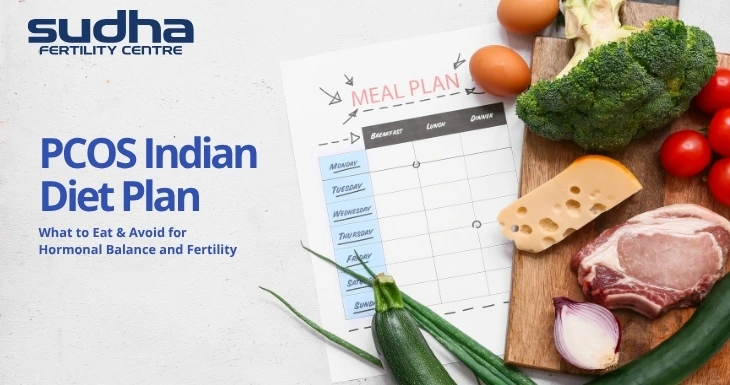
PCOS Indian Diet Plan: What to Eat and Avoid for Hormonal Balance and Fertility
What Indian Foods Help Manage PCOS Naturally?
-
- Finger Millet (Ragi) – very low GI; slows glucose absorption and prevents insulin spikes
- Fenugreek (Methi) – improves insulin sensitivity and lowers androgen levels
- Flaxseeds – Flaxseeds contain lignans that increase SHBG (a protein that binds free testosterone in the blood), helping to reduce active androgen levels in the body. They also provide omega-3 fats and fibre that support hormonal balance.
- Amla (Indian Gooseberry) – richest natural Vitamin C source; detoxifies liver and regulates hormones
- Bitter Gourd (Karela) – natural compounds mimic insulin action and lower blood sugar
- Turmeric – Turmeric (curcumin) is a potent anti-inflammatory and antioxidant. Clinical studies show it may help improve insulin sensitivity and reduce androgens in PCOS, although direct evidence for ovulation support is still emerging.
- Drumstick Leaves (Moringa) – rich in iron, folate, and Vitamin C; supports reproductive health
- Spinach and Leafy Greens – folate and magnesium antioxidants support ovarian health
- Curd – probiotic that supports the gut-hormone axis and reduces inflammation
- Tulsi Leaves – anti-androgenic; reduces cortisol and supports menstrual regularity
Women with PCOS who follow a consistent low-GI, anti-inflammatory Indian diet often sees improvements in menstrual regularity within 2 to 6 months. Individual response varies based on the severity of insulin resistance, baseline weight, and consistency of dietary change.
A PCOS diagnosis arrives with a lot of confusion. A woman is told her hormones are imbalanced, told to watch her diet, but no one explains what that actually means in the context of the food she eats every day. Does it mean giving up rice? Are all fruits forbidden? Can she still eat what’s cooked in her home? This confusion leads to either complete avoidance of dietary changes or random restrictions that do not address the actual problem.
This guide is the explanation her doctor should have given. It covers the science of why diet matters so much in PCOS, which Indian foods support fertility and hormonal balance, which ones to reduce, and a full seven-day meal plan using the foods that are already in South Indian kitchens. The goal is not a restrictive diet that feels punishing. It is a way of eating that works with her body, not against it.
Why Diet Matters the Most in PCOS
PCOS is fundamentally a metabolic and hormonal condition. Study states that 1 in 5 women have PCOS in India. In most women with PCOS, the root driver is insulin resistance. This means the body’s cells do not respond properly to insulin, so the pancreas has to overproduce insulin to compensate.
When insulin levels are chronically high, they send a signal to the ovaries to produce excess androgens, which are male hormones like testosterone. These androgens disrupt ovulation, cause irregular or absent periods, and lead to the visible symptoms of PCOS like acne, excess body hair, and weight gain.
Here is the food connection: foods that cause blood sugar to spike quickly (high glycemic index or high-GI foods like white rice and refined flour) force the pancreas to produce even more insulin. This worsens insulin resistance and worsens all the hormonal problems. Foods that release sugar slowly (low-GI foods like millets, dal, and vegetables) keep blood sugar stable, reduce the demand for insulin, lower androgen levels, and allow ovulation to return.
The evidence is clear. A clinical study found that 95% of women on a low-GI diet reported menstrual cycle regularity compared to only 63% on a conventional healthy diet. Research states that in overweight women with PCOS, even a 5 to 10% reduction in body weight through dietary changes restores ovulation. Studies show menstrual cycle regularity improves in 30-80% of women, with higher success rates in those with mild-to-moderate insulin resistance. This is not about willpower. It is about giving the body the fuel it needs to regulate itself.
The 3 Principles of a PCOS-Friendly Diet
Before diving into specific foods, remember three core principles that guide every choice:
- Low GI first Choose foods that release sugar slowly to prevent insulin spikes and reduce insulin demand
- Anti-inflammatory Reduce foods that worsen systemic inflammation, which drives PCOS symptoms
- Androgen-lowering Some foods actively reduce testosterone levels and support hormonal balance
Indian Foods to Eat for PCOS
Millets and whole grains:
Finger Millet, Pearl Millet, Sorghum Millet, brown rice, oats, and multigrain roti are all low-GI alternatives to white rice. White rice is rapidly absorbed and causes a sharp insulin spike. Millets are absorbed slowly, keeping blood sugar stable for hours. They are also high in fibre and calcium, which support hormonal regulation. Try replacing white rice with millets at least three to four times per week. A Finger Millet dosa or Pearl Millet roti is just as satisfying as a white rice meal but does not destabilize your hormones.
Pulses and legumes:
Red Lentil, Yellow lentils, pigeon pea, Kidney beans, chick pea, and sprouts are among the best foods for PCOS. They are high in protein and fibre, both of which slow glucose absorption and reduce insulin demand. Pulses also contain compounds that support liver function, which is important for hormone metabolism. A pulse-based meal is ideal for PCOS because the combination of protein, fibre, and low-GI carbohydrates keeps blood sugar and hormones stable.
Vegetables:
Spinach, Fenugreek leaves, Ladies Finger, Bitter gourd, Drumstick leaves, cabbage, capsicum, brinjal, ridge gourd, and tomatoes are all PCOS-friendly. Bitter Gourd specifically contains compounds that mimic insulin action and naturally lower blood sugar. Spinach and drumstick leaves are rich in iron and folate, essential for ovulation and fertility. These vegetables should form the base of every PCOS meal.
Low-GI fruits:
Guava, amla, apple, orange, mosambi, and papaya (in moderation) are excellent choices. Guava and amla are particularly valuable: guava is extremely low-GI and high in Vitamin C for hormone regulation, while amla is the richest natural source of Vitamin C and acts as a natural detoxifier. Avoid very sweet fruits like mango, grapes, Sapota, and watermelon in large quantities as they are high-GI.
Healthy fats:
Flaxseeds, sesame, coconut in moderation, walnuts, and almonds all support hormonal health. Flaxseeds are particularly important: they are rich in lignans that block androgen receptors, helping reduce the effects of excess testosterone. Grind flaxseeds before eating them (whole seeds pass through undigested) and add one tablespoon to dosa batter, roti flour, or curd.
Protein sources:
Eggs, paneer, curd, and chicken in moderation are excellent protein sources. Protein slows digestion and prevents blood sugar spikes. Curd is particularly valuable because it is fermented, which makes it probiotic and supportive of gut health, which is increasingly recognized as important for hormone regulation.
Fermented foods:
Curd, idli, dosa, and kanji all support gut health. Fermentation increases nutrient absorption and creates beneficial bacteria that influence hormonal metabolism. Include fermented foods at multiple meals throughout the day.
Indian Foods to Avoid or Reduce for PCOS
Be clear on the reason for each, because understanding the why makes changes stick:
High-GI carbohydrates:
White rice, Refined flour, white bread, and biryani made with refined rice spike blood sugar and insulin rapidly. This directly worsens PCOS. Reduce portions and replace with millets or brown rice.
Sugary foods and drinks:
Tea with too much sugar is a particular culprit in India. Two cups of sugary tea per day adds significant sugar and destabilizes blood sugar throughout the day. Avoid packaged juices, soft drinks, biscuits, and chocolates. Save sweets for rare occasions.
Deep-fried foods:
Samosas, pakoras, bajji, and puri contain Trans fats that worsen inflammation. PCOS is fundamentally an inflammatory condition, and deep-fried foods fuel the fire. Reduce dramatically.
Processed and packaged foods:
Mixture snacks, chips, instant noodles contain hidden sugars and refined oils that worsen both insulin resistance and inflammation.
Excess dairy:
Full-fat milk in large quantities and excess ghee has been shown to raise androgen levels in some PCOS women. Moderate amounts of curd and paneer are fine, but if your cycles are irregular, reducing full-fat milk may help.
High-GI fruits:
Mango, grapes, Sapota, and watermelon in large quantities are high-GI. Eating one or two is fine, but avoid large servings.
Important: This is about reduction and balance, not elimination. A sustainable diet is one where you actually enjoy the food you eat.
12 Indian Super Foods for PCOS
These are foods that are already part of South Indian cooking and have specific, clinically-studied benefits for PCOS and fertility.
|
Superfood |
What It Does |
How to Include It |
|
Fenugreek |
Improves insulin sensitivity; lowers androgen levels; supports menstrual regularity | In paratha, dal, or soak seeds overnight and drink the water |
|
Turmeric |
Potent anti-inflammatory; supports ovulation; reduces androgen production | Turmeric milk before bed; add to every dal and curry; turmeric rice |
|
Flaxseeds |
Rich in lignans that block androgen receptors; reduces testosterone excess; high omega-3 | Grind and add 1 tbsp to dosa batter, roti flour, curd, or smoothies |
|
Amla / Indian Gooseberry |
Highest natural Vitamin C; powerful antioxidant; detoxifies liver; regulates hormones | Amla juice in the morning; amla pickle; raw amla; amla in Honey without excess sugar |
|
Finger Millet |
Very low GI; high calcium and iron; high fibre; slows glucose absorption | Finger Millet dosa, Finger Millet Kali, Finger Millet porridge, Finger Millet laddoo without excess jaggery |
|
Bitter Gourd |
Natural insulin sensitizer; contains compounds that mimic insulin action | Bitter Gourd curry, Bitter Gourd juice (mixed with amla or lemon to reduce bitterness) |
|
Walnut and Almonds |
Rich in omega-3 fatty acids & Vitamin E, anti-inflammatory; support ovarian health and hormonal balance. | Handful (4-5) as snack; Soak 4 – 5 overnight; add to salads; include in breakfast |
|
Drumstick leaves / Moringa |
Rich in iron, folate, calcium, Vitamin C; anti-inflammatory; supports reproductive health | Include Moringa in curry, dal, sambar |
|
Curd |
Probiotic; supports gut-hormone axis; reduces inflammation; provides calcium | With meals instead of pickle; Butter milk as evening drink; dip with vegetables |
|
Spinach |
High in iron, folate, magnesium; antioxidants support ovarian health; low GI | Dal, paneer, dosa, paratha, add to smoothies |
|
Coconut water |
Natural electrolytes; gentle on blood sugar (GI around 55); supports insulin function | 1 glass mid-morning or post-exercise; fresh only, not packaged |
|
Tulsi leaves |
Anti-androgenic properties; reduces cortisol; supports menstrual regularity; liver-protective | Tulsi tea each morning (4 to 6 leaves in hot water); add to herbal teas |
Indian PCOS Diet: A 7-Day South Indian Meal Plan
This is a sample template only. Portions and specific meals should be personalized with your doctor or nutritionist based on your weight, medications, and specific PCOS type.
|
Day |
Breakfast | Lunch | Snack |
Dinner |
|
Day 1 |
2 Finger Millet dosas + sambar + coconut chutney (1 tsp) + 1 glass buttermilk | 1 cup brown rice + drumstick sambar + palak kootu + curd | 1 apple + handful roasted groundnuts | 2 fenugreek chapatis + mixed vegetable curry (ladies finger, capsicum, tomato) + curd |
|
Day 2 |
Oats upma with vegetables (carrot, beans, peas) + 1 boiled egg or 50g paneer | 2 Sorghum Millet rotis + Kidney beans curry + Bitter Gourd sabzi + salad | 1 guava or orange + 4 to 5 soaked almonds | 1 cup Yellow lentils khichdi (more dal, less rice) + cucumber dip |
|
Day 3 |
2 idlis + sambar + 1 tsp groundnut chutney + 1 small amla or amla juice | 1 cup Finger Millet kali + Moringa kootu + rasam + curd | Sprout sabzi (green gram + lemon + coriander + onion) + coconut water | 2 multigrain chapatis + mixed dal + ladies finger sabzi |
|
Day 4 |
Poha (thick, not thin) with vegetables + fenugreek seeds + coriander + 1 cup green tea | Brown rice 3/4 cup + avial (mixed vegetables in coconut) + buttermilk + salad | Small bowl papaya + 5 walnuts | 1 cup lemon rice (with less oil, more vegetables) + curd |
|
Day 5 |
2 vegetable dosa + coconut chutney (1 tsp) + 1 glass buttermilk | 2 Pearl Millet rotis + dal + palak sabzi + curd | Roasted flaxseed brittle (1 small piece, jaggery-based) or 1 cup cumin water + handful peanuts | Mixed vegetable soup (no cream) + 1 Finger Millet dosa |
|
Day 6 |
Chickpea dosa (2 medium) with fenugreek + green chutney + 1 boiled egg (optional) | 1 cup steamed millet+ Chick pea dal curry + cucumber curd raita | Pomegranate (1 small cup) + 4 to 5 soaked almonds | 2 Yellow lentils dosas + tomato chutney + curd |
|
Day 7 |
Overnight oats with banana (1/3), flaxseeds (1 tbsp), chia seeds, curd | 2 whole wheat chapatis + Kidney beans + mixed vegetable sabzi + curd | buttermilk with cumin + 1 small fruit | Rice kanji (or Finger Millet kanji) or light dal soup + 1 roti |
Lifestyle Alongside Diet: What Multiplies Results
Diet is powerful, but it works best alongside other lifestyle changes:
- Exercise: 30 minutes of moderate activity on most days (brisk walking, cycling, yoga, swimming) improves insulin sensitivity independently of weight loss
- Sleep: Seven to eight hours per night is critical. Poor sleep worsens cortisol and insulin resistance, making PCOS symptoms worse
- Stress management: Chronic stress raises cortisol, which worsens insulin resistance and androgen excess. Yoga, pranayama, and meditation are particularly relevant and directly support hormonal balance
Important note: avoid extreme calorie restriction. It can worsen hormonal disruption and may slow metabolism long-term. The goal is sustainable eating, not punishment.
Managing PCOS through Food: The Start of Something Bigger
A PCOS diagnosis can feel overwhelming. But diet is one area where you have immediate control. The food choices made today influence hormone levels tomorrow, menstrual regularity next month, and fertility in the months ahead.
The good news: the foods that are best for PCOS are the same foods that have been part of South Indian cooking for generations. Finger Millet, Fenugreek, dal, curd, Moringa, and turmeric are not exotic or expensive. They are already part of most South Indian kitchens. This is not about foreign super foods or restrictive eating. It is about using what is already available at your home to support the body’s natural healing.
At Sudha Fertility Centre, Dr. S. Dhanabagyam and Dr. S. Pradeepa view PCOS management holistically. Diet, exercise, sleep, stress management, and medical treatment all work together. Our doctors assess your hormonal profile, identify your PCOS type, and create a personalized treatment and lifestyle plan that works for your body and your fertility goals. Sudha Fertility Centre has dedicated teams across Bangalore, Hyderabad, Chennai, and Coimbatore to support couples through every stage of PCOS management and fertility treatment.
If an IVF cycle is not successful or hormonal balance is not improving with diet changes, the team will review what happened, discuss what other conditions affecting fertility be adjusted, and outline the next steps before any further decisions are made.
Disclaimer: This article is for general informational purposes only and does not constitute medical advice. PCOS management should always be done in consultation with a qualified fertility specialist or endocrinologist based on individual clinical assessment.
Frequently Asked Questions
What should I eat for PCOS to get pregnant?
Can women with PCOS eat rice?
Which Indian millets are best for PCOS?
Can Women with PCOS Eat Fruits?
How does fenugreek help with PCOS?
Which Indian foods are best for PCOS?
What foods should strictly avoid a women with PCOS?
Is curd (yoghurt) good for women with PCOS?
Does exercise need to accompany dietary changes for PCOS?
How long does it take to see results from a PCOS diet change?

Dr. S. Pradeepa is a fertility specialist at Sudha Fertility Centre, Erode, with expertise in IVF, IUI, ICSI, PCOS, and endometriosis. She holds MBBS, DGO, DNB (OG), and a Fellowship in Reproductive Medicine. Known for her patient-centric approach, she provides personalized, evidence-based care and reviews medical content to guide informed fertility decisions.