
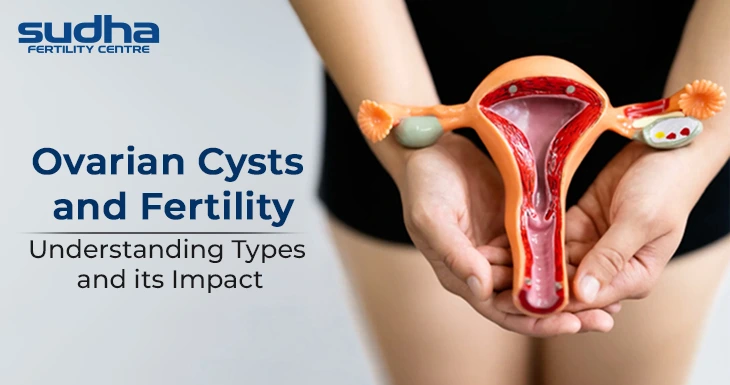
Ovarian Cysts and Fertility: Understanding Types and Its Impact
How Ovarian Cysts Affect Fertility
- Functional Cysts – usually do not affect fertility and indicate normal ovulation
- Endometriomas – can damage ovarian tissue and reduce egg reserve
- PCOS-Related Cysts – hormonal imbalance disrupts regular ovulation
- Large Ovarian Cysts – may interfere with normal ovarian function
- Ovarian Torsion Risk – severe cysts can twist the ovary and affect fertility
- Hormonal Changes – cysts may cause irregular menstrual cycles
- Egg Quality Impact – certain cysts can reduce egg quality and implantation chances
- Repeated Surgeries – multiple cyst removal surgeries may lower ovarian reserve
- Early Diagnosis – timely treatment helps preserve reproductive health
- Fertility Support – proper treatment and fertility care improve pregnancy chances
Getting a report of an ovarian cyst can feel anxious, especially when you do not yet understand what it means for you. But before you worry, here is what you need to know right away: most ovarian cysts are completely harmless and resolve on their own without any treatment or intervention. Fewer than 1% of ovarian cysts are cancerous according a reasearch. The critical question is not whether you have a cyst. It is what type of cyst it is, because different types carry very different implications for your fertility and your need for treatment.
This guide explains which types of ovarian cysts you might have discovered, what each type means specifically for your fertility, when surgery is genuinely needed and when it absolutely is not, and what warning signs require urgent emergency care. By the end of this article, you will understand your ultrasound findings in the proper context, and you will know exactly what your next steps should be.
What Is an Ovarian Cyst?
An ovarian cyst is a fluid-filled sac that develops on or inside an ovary. They are mostly common. Most reproductive-age women will develop an ovarian cyst at some point in their reproductive years. Many women have cysts without ever knowing it because they cause no symptoms and quietly resolve on their own.
Here is the most important thing: the word ‘cyst’ sounds frightening, but most cysts are simply normal physiological events related to your menstrual cycle. Every month, your ovary forms a small fluid-filled sac as part of the normal ovulation process. When the ovary releases an egg, sometimes the follicle does not empty or fills with fluid after ovulation. This is not a disease. It is how ovaries naturally work.
The real clinical question is not ‘do I have a cyst?’ It is ‘what type of cyst is it?’ because different types have very different meanings and management needs. Some cysts are harmless and disappear within weeks. Others may need monitoring. A few may eventually need treatment. The specific type determines whether you need to do anything at all.
Types of Ovarian Cysts: The Most Important Distinction
Not all ovarian cysts are the same. The differences matter significantly. Understanding which type you have is vital to your management and fertility planning.
|
Type |
Typical Features | Fertility Impact |
Standard Management |
| Functional cyst (follicular or corpus luteum) | Most common type, thin-walled, fluid-filled, 2-5 cm, resolves in 1-3 cycles |
Minimal |
Watchful waiting; repeat ultrasound in 6-8 weeks |
| Hemorrhagic corpus luteum cyst | Functional cyst that bled internally; complex appearance on ultrasound; resolves in 4-6 weeks |
Minimal |
Monitor with repeat ultrasound; pain control; usually no surgery needed |
| Dermoid cyst (mature cystic teratoma) | Contains hair, skin, teeth, fat; benign in 98-99%; smooth, 4-10 cm; do NOT resolve on their own; risk of torsion |
Mild (surgery reduces reserve) |
Monitor if <5 cm; surgical removal is often recommended at some point; preserve ovarian tissue carefully. |
| Endometrioma (chocolate cyst) | Endometriosis tissue on ovary; filled with old dark blood; ground-glass appearance; 3-6 cm commonly |
Moderate to severe |
Watchful waiting if asymptomatic and <4 cm; surgery may reduce reserve, see specialist discussion |
| Serous and mucinous cystadenoma | Develop from ovarian surface cells; can grow large, thin-walled, mostly benign; usually unilateral. |
Minimal |
Surgery once persistent or >5-7 cm; cystectomy typically does not significantly affect ovarian reserve |
| PCOS-related multiple follicles | Multiple small follicles (12+ per ovary) around periphery; ‘string of pearls’ appearance; NOT true cysts |
Through a hormonal mechanism |
Hormonal/metabolic management; weight optimisation; no surgery for follicles |
| Malignant ovarian tumour | Rare in reproductive-age women (<1%); solid components, thick septations, papillary projections, free fluid, elevated CA-125 |
Treatment-dependent |
Urgent specialist referral; staging surgery; oncology team approach |
Symptoms: Most Cysts Cause None
Here is an important fact: many women have ovarian cysts with absolutely no symptoms at all. The cyst was discovered purely by chance on ultrasound. This is the norm, not the exception. When symptoms do occur, they can include lower pelvic pressure or fullness on one side, dull or achy pain in the lower pelvis, pain during intercourse, worsening period pain or unusual spotting, pressure on the bladder causing frequent urination, pressure on the bowel causing constipation or discomfort, or bloating and abdominal fullness.
None of these symptoms is specific to ovarian cysts. They can result from many other conditions. Your doctor will consider the complete clinical picture, imaging findings, and sometimes additional tests.
|
Symptom |
What It Suggests |
Urgency |
| No symptoms (incidental finding on ultrasound) | Most commonly, usually a functional cyst that will resolve |
Routine |
| Mild pelvic ache or pressure on one side | Usually, a functional cyst stretches the ovarian capsule, and it resolves with the cyst. |
Routine |
| Pain during intercourse | Could be dermoid, endometrioma, a large simple cyst, or unrelated endometriosis |
Soon |
| Bloating, fullness, frequent urination | Larger cysts compressing nearby organs |
Soon |
| Sudden severe pelvic pain on one side, nausea, vomiting | Ovarian torsion; the ovary has twisted on the blood supply |
Emergency |
| Sudden sharp pain, feeling faint or dizzy | Cyst rupture with internal bleeding |
Emergency |
| Persistent swelling, weight loss, fatigue, loss of appetite | Possible malignancy |
Emergency |
How Do Ovarian Cysts Affect Fertility?
Short answer: Most ovarian cysts do NOT affect your fertility. Functional cysts have zero fertility impact and resolve naturally. Cystadenomas have minimal to no impact. However, endometriomas DO reduce ovarian reserve through chronic inflammation and tissue damage.
The 2025 clinical evidence confirms that surgery for endometriomas and dermoids significantly reduces ovarian reserve in the months after surgery, while surgery for serous and mucinous cystadenomas has minimal impact. When deciding whether a cyst affects pregnancy, your doctor should weigh: Is it causing severe symptoms? Is malignancy suspected? How much ovarian reserve will be lost if we operate? Are you planning a pregnancy soon?
For women planning pregnancy, sometimes watchful waiting is far safer and more fertility-preserving than surgery.
When Does an Ovarian Cyst Need to Be Removed?
This is the question keeping many women anxious. The answer depends on type, size, symptoms, and fertility plans.
|
Scenario |
Recommended Approach |
Why |
| Functional cyst <5 cm, no symptoms, reproductive-age woman | Watchful waiting; repeat ultrasound in 6-8 weeks | Most resolve in 1-3 cycles; surgery would damage the healthy ovary unnecessarily. |
| Dermoid cyst <5 cm, no symptoms, fertility plans | Monitor with annual ultrasound; consider surgery if growing or before pregnancy planning. | Surgery reduces ovarian reserve; balance growth/torsion risk against fertility preservation. |
| Dermoid cyst >5 cm or growing | Surgery (cystectomy) is recommended | Increased torsion risk; growth typically continues; preserve as much ovarian tissue as possible |
| Endometrioma <4 cm, planning IVF, no severe pain | DO NOT operate routinely before IVF (per 2025 BJOG guideline) | Surgery does not improve IVF live birth rates and reduces ovarian reserve |
| Endometrioma >4 cm interfering with retrieval or causing severe pain | Consider surgery; weigh against ovarian reserve impact; specialist surgeon | Mechanical access for IVF or a significant symptom burden may justify reserve loss |
| Suspected malignancy (solid components, papillary projections, ascites, elevated CA-125) | Urgent gynaecology-oncology referral; staging surgery | Rule out malignancy; treatment must follow oncology protocols |
| Persistent simple cyst >5 cm, no resolution after 3-6 months | Surgery (cystectomy) reasonable | Persistence beyond 6 months suggests not functional; size increases torsion/rupture risk. |
| PCOS-related multifollicular ovaries | NEVER surgery for the follicles; treat the syndrome hormonally and lifestyle-based | These are not cysts that can be removed; the syndrome is metabolic |
| Cyst found during pregnancy | Monitor; most resolve by mid-second trimester; surgery only if essential, ideally in the second trimester | Pregnancy itself causes corpus luteum cysts; surgery is avoided when possible. |
Critical point for women planning pregnancy: if surgery is indicated, the surgical technique matters enormously. Careful cystectomy with suture hemostasis preserves far more ovarian tissue than aggressive bipolar electrocoagulation. Always discuss surgical technique specifically with your surgeon.
Emergency Signs: When to Seek Urgent Care
Some cyst-related events are genuine emergencies requiring immediate evaluation. Do not wait.
- Ovarian torsion: sudden onset of severe pelvic pain on one side, nausea, vomiting, and possibly fever. The ovary has twisted on its blood supply. If not surgically relieved within hours, the ovary can be permanently lost.
- Cyst rupture: sudden, sharp pelvic or lower abdominal pain, sometimes shoulder pain from referred bleeding, feeling faint or dizzy from blood loss. Requires emergency evaluation.
- Suspected malignancy: persistent abdominal swelling, unexplained weight loss, loss of appetite, fatigue. Needs urgent specialist evaluation.
Remember: if you have a known ovarian cyst and develop sudden, severe pelvic pain, nausea, or feel faint, do not wait. Seek emergency medical care immediately.
PCOS vs Ovarian Cysts: The Important Distinction
This distinction is crucial because it is so often misunderstood, and misunderstanding leads to inappropriate clinical decisions.
PCOS is NOT ‘having ovarian cysts.’ PCOS (Polycystic Ovary Syndrome) is a hormonal and metabolic disorder characterised by: irregular or absent ovulation, elevated androgen hormones (causing acne, facial hair, scalp hair loss), and multiple small immature follicles on ultrasound in a ‘string of pearls’ pattern. These small follicles are NOT cysts in the surgical sense. They are immature follicles that failed to develop properly because of a hormonal imbalance.
Critical point: these follicles cannot and should not be surgically removed. They exist because of a hormone imbalance, and removing them does not fix the imbalance. Treatment for PCOS is hormonal and lifestyle-based: weight management, dietary changes, ovulation induction if trying to conceive, or hormonal contraceptives if not planning pregnancy. PCOS is NEVER treated with surgery on the ovaries.
Cysts During Pregnancy
Many women discover an ovarian cyst on a routine pregnancy ultrasound. The most common is a corpus luteum cyst, which is completely normal and actually supports early pregnancy by producing progesterone. It typically resolves by 14 to 16 weeks without treatment. Pre-existing cysts discovered during pregnancy are sometimes managed through monitoring rather than immediate surgical removal.
Management in pregnancy includes monitoring as the standard for most cysts, avoidance of surgery when possible (if necessary, the second trimester is safest), and reassurance that cysts rarely affect pregnancy outcome. Rest assured: cysts discovered during pregnancy rarely cause problems.
Next Steps: Getting the Clarity You Deserve
Most ovarian cysts are harmless and resolve on their own. But knowing what type you have requires proper evaluation by a fertility specialist. At Sudha Fertility Centre, our specialists distinguish between cysts that need watchful waiting, cysts that need fertility-focused management, and cysts that genuinely warrant surgery. Our laparoscopic surgery team prioritises ovarian reserve preservation when surgery is truly indicated.
If you have been told you have an ovarian cyst and need clarity on what it means for your fertility and your future, our team at Sudha Fertility Centre is ready to listen, explain, and guide you through the best path forward.
Book your free consultation at Sudha Fertility Centre, Bangalore, Hyderabad, Chennai, or Coimbatore today.
Disclaimer: This article is educational and does not replace professional medical advice. It is based on current clinical evidence and guidelines as of 2025. Ovarian cyst management must be individualised based on imaging findings, symptoms, reproductive goals, and clinical assessment. Always consult a qualified fertility specialist or gynaecologist for diagnosis, investigation, and treatment recommendations specific to your individual situation. If you experience sudden, severe pelvic pain, fever, or feeling faint, seek emergency medical care immediately.
Frequently Asked Questions
Can ovarian cysts cause infertility?
Which ovarian cysts affect fertility the most?
Can I get pregnant naturally with an ovarian cyst?
What are the symptoms of ovarian cysts?
Do ovarian cysts go away on their own?
Is surgery necessary for ovarian cysts?
Can ovarian cysts become cancerous?
How are ovarian cysts diagnosed?
Can PCOS cysts affect pregnancy chances?
When should I see a doctor for an ovarian cyst?

Dr. S. Pradeepa is a fertility specialist at Sudha Fertility Centre, Erode, with expertise in IVF, IUI, ICSI, PCOS, and endometriosis. She holds MBBS, DGO, DNB (OG), and a Fellowship in Reproductive Medicine. Known for her patient-centric approach, she provides personalized, evidence-based care and reviews medical content to guide informed fertility decisions.