

Azoospermia Explained: Obstructive vs Non-Obstructive & Advanced Treatment Options
Hearing the word azoospermia can feel like a door slamming shut on your dream of becoming a parent. We understand that fear. At Sudha Fertility Centre, we have walked this path with thousands of couples, and we can say with confidence: a diagnosis of azoospermia is not the end of your journey. It is the beginning of finding the right path forward.
In this guide, we break down what azoospermia really means. We explain the two main types, the causes behind each, and — most importantly — the advanced treatment options available today. Because knowledge is the first step toward hope.
What Is Azoospermia?
Azoospermia is a medical condition where a man’s ejaculate contains no sperm at all. It affects roughly 1% of all men and is found in about 10–15% of men who struggle with infertility. While this may sound alarming, the key fact is that azoospermia is often treatable — especially with the advanced reproductive technologies available at leading fertility hospitals like Sudha Fertility Centre.
A simple semen analysis is usually the first step in diagnosing azoospermia. When semen analysis shows zero sperm count, further evaluation is needed to determine the type and underlying cause.
The Two Main Types of Azoospermia
Understanding which type of azoospermia you have is critical. Treatment strategies differ significantly depending on the type. Broadly, there are two categories:
1. Obstructive Azoospermia (OA)
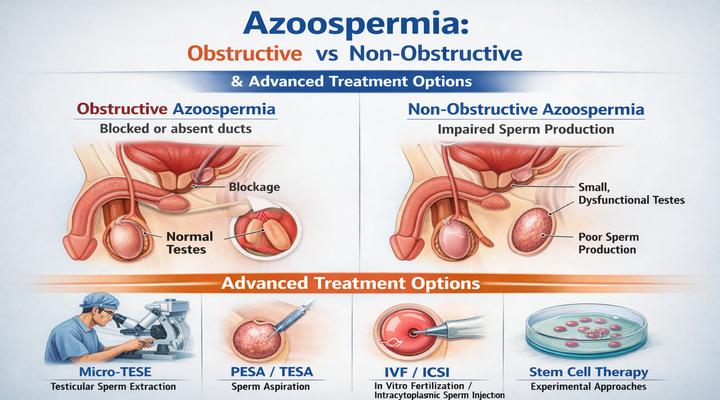
In obstructive azoospermia, the testes produce sperm normally. However, a blockage somewhere in the reproductive tract prevents sperm from reaching the ejaculate. Think of it like a pipeline with healthy flow but a blocked valve.
Common causes of obstructive azoospermia include:
- Previous vasectomy (intentional surgical blockage)
- Infections such as epididymitis or sexually transmitted infections
- Congenital bilateral absence of the vas deferens (CBAVD), often linked to cystic fibrosis gene mutations
- Injury or scarring from prior surgeries
- Ejaculatory duct obstruction
Because sperm production is intact, obstructive azoospermia often has very favorable treatment outcomes. Men with OA tend to respond well to surgical sperm retrieval and assisted reproductive technology (ART).
2. Non-Obstructive Azoospermia (NOA)
Non-obstructive azoospermia is more complex. Here, the problem lies in sperm production itself. The testes either produce very few sperm or none at all. There is no physical blockage — the issue is at the level of sperm manufacturing.
Causes of non-obstructive azoospermia include:
- Hormonal imbalances affecting the pituitary-testicular axis
- Genetic abnormalities such as Klinefelter syndrome (XXY) or Y-chromosome microdeletions
- Undescended testicles (cryptorchidism) in childhood
- Exposure to chemotherapy or radiation
- Varicocele — enlarged veins in the scrotum that raise testicular temperature
- Certain medications and toxins
NOA is more challenging, but it is not hopeless. Advanced techniques can sometimes retrieve viable sperm even from testes with very low production. Our specialists at Sudha Fertility Centre assess every patient individually before drawing any conclusions.
Obstructive vs Non-Obstructive Azoospermia: Key Differences
Understanding the distinctions helps set realistic expectations:
- Sperm Production — OA: Normal | NOA: Impaired or absent
- Hormones (FSH, LH, Testosterone) — OA: Usually normal | NOA: Often abnormal
- Testicular Size — OA: Usually normal | NOA: May be smaller
- Primary Cause — OA: Blockage | NOA: Testicular failure or hormonal issue
Surgical Sperm Retrieval Success Rate — OA: High | NOA: Variable, requires expert evaluation
How Is Azoospermia Diagnosed?
Diagnosis involves more than just a semen analysis. At Sudha Fertility Centre, our fertility specialists follow a thorough diagnostic protocol:
- Semen Analysis (at least two separate tests)
- Hormone Profile — FSH, LH, testosterone, prolactin
- Scrotal Ultrasound — to detect varicocele, obstruction, or testicular abnormalities
- Genetic Testing — karyotype analysis, Y-chromosome microdeletion test, CFTR gene mutation screening
- Testicular Biopsy — to assess sperm production directly when needed
Our advanced embryology lab supports every diagnostic step. We use state-of-the-art equipment to ensure accurate, reliable results — because the right diagnosis leads to the right treatment.
MESA (Microsurgical Epididymal Sperm Aspiration): A microsurgical procedure that collects sperm from the epididymal tubules. It typically yields higher numbers of good-quality sperm than PESA.
TESA (Testicular Sperm Aspiration): Sperm are aspirated directly from the testicular tissue using a needle. This is often used for both OA and NOA cases.
TESE / Micro-TESE (Testicular Sperm Extraction): Small pieces of testicular tissue are surgically removed and examined under a microscope for sperm. Micro-TESE uses operating microscopes to identify the best areas of sperm production — making it the gold standard for non-obstructive azoospermia.
ICSI — Intracytoplasmic Sperm Injection
Once sperm are retrieved, they are used in ICSI — one of the most powerful tools in reproductive medicine. In ICSI, a single healthy sperm is injected directly into a mature egg. This bypasses the need for sperm to fertilize an egg naturally.
ICSI is particularly valuable for male infertility cases because even a small number of surgically retrieved sperm can potentially lead to successful fertilization and pregnancy. At Sudha Fertility Centre, our embryologists are highly skilled in ICSI — a procedure that requires precision at the microscopic level.
IVF Combined with Surgical Sperm Retrieval
In most azoospermia cases, surgical sperm retrieval is combined with IVF (In Vitro Fertilization). The retrieved sperm fertilize eggs in our advanced embryology lab. The resulting embryos are cultured, assessed for quality, and then transferred to the uterus.
Our embryology lab at Sudha Fertility Centre is equipped with cutting-edge technology including time-lapse incubators, preimplantation genetic testing capabilities, and vitrification (rapid freezing) systems. These tools help maximize embryo quality and pregnancy success rates.
Hormonal and Medical Treatment
For non-obstructive azoospermia caused by hormonal deficiencies, medical treatment can sometimes stimulate sperm production. Medications such as gonadotropins (FSH, HCG injections) or clomiphene citrate may be prescribed.
However, medical treatment works best in specific hormonal conditions — particularly hypogonadotropic hypogonadism. Our specialists carefully evaluate hormone profiles before recommending this approach.
Varicocele Repair
If a varicocele is identified as the cause of NOA, surgical repair (varicocelectomy) may improve sperm production over time. In some men, this can restore sperm in the ejaculate — eliminating the need for surgical retrieval. This is an important consideration before proceeding directly to ART.
Donor Sperm as an Alternative
In cases where no sperm can be retrieved and hormonal treatment has not worked, using donor sperm through IUI or IVF is another option. This allows couples to still experience pregnancy and parenthood. Our counseling team at Sudha Fertility Centre supports couples through this decision with compassion and without judgment.
Fertility Preservation for Men at Risk
Men facing cancer treatment, surgery, or other conditions that may affect fertility should consider sperm banking before treatment begins. Freezing sperm preserves future reproductive options. At Sudha Fertility Centre, we offer comprehensive fertility preservation services — including sperm cryopreservation with long-term storage facilities.
Why Choose Sudha Fertility Centre for Azoospermia Treatment?
Sudha Fertility Centre is one of South India’s most trusted names in reproductive medicine. Founded by Dr. K. Sudhakar, our centre has built its reputation over 40+ years of clinical excellence. Today, we have 25+ branches across India and international locations — making expert fertility care accessible to more families.
Here is what sets us apart:
- Expert specialists including Dr. S. Dhanabagyam and Dr. S. Pradeepa, with decades of experience in complex male infertility cases
- Advanced Embryology Labs equipped with the latest reproductive technology
- Personalized treatment plans — no two patients receive the same approach
- Integrated care covering diagnostics, surgery, IVF, ICSI, and counseling under one roof
- Free fertility counseling to help couples understand their options without pressure
- A legacy of thousands of successful pregnancies, including many where azoospermia was the primary challenge
We have helped couples from across Tamil Nadu and South India find their path to parenthood. Many came to us after being told elsewhere that treatment was impossible. We believe in exploring every option — because every patient deserves a thorough evaluation before accepting a final answer.
You Are Not Alone on This Journey
A diagnosis of azoospermia can feel isolating. Many men hesitate to talk about it — with their partners, families, or even doctors. But male infertility is a medical condition, not a reflection of strength or identity. It deserves the same compassionate, expert care as any other health issue.
At Sudha Fertility Centre, we create a safe space for open conversations. Our team understands that fertility treatment is an emotional journey, not just a medical one. We are here for you at every step — from the first consultation to the joy of a positive pregnancy test.
When Should You See a Fertility Specialist?
If you and your partner have been trying to conceive for 12 months without success (or 6 months if either of you is over 35), it is time to consult a fertility specialist. For couples where the male partner has a known condition — such as a past infection, varicocele, undescended testicle, or genetic disorder — evaluation should begin sooner.
Early evaluation leads to earlier treatment and better outcomes. Do not wait to seek help. Reach out to our team at Sudha Fertility Centre, one of the best fertility hospitals in Chennai and across Tamil Nadu, for a detailed assessment.
Conclusion
Azoospermia is a complex condition — but it is far from a dead end. Whether obstructive or non-obstructive, modern reproductive medicine offers meaningful treatment options. From surgical sperm retrieval to ICSI and IVF, the tools available today have transformed what is possible for couples facing this diagnosis.
At Sudha Fertility Centre, our goal is simple: to give every couple the best possible chance at parenthood. With 40+ years of experience, advanced infrastructure, and a team of deeply committed specialists, we approach every case with hope, precision, and care.
If you or someone you love has been diagnosed with azoospermia, do not navigate this alone. Contact Sudha Fertility Centre today for a personalized consultation. Take the first step — because your family-building journey deserves expert support.
Frequently Asked Questions (FAQ)
Q1. Can a man with azoospermia father a biological child?
Yes, in many cases. If sperm can be retrieved surgically — through PESA, TESA, TESE, or Micro-TESE — those sperm can be used in ICSI and IVF to achieve fertilization. Success depends on the type of azoospermia and the amount of sperm retrieved. Our specialists at Sudha Fertility Centre evaluate each case thoroughly to determine the best approach.
Q2. How is obstructive azoospermia different from non-obstructive azoospermia?
In obstructive azoospermia, sperm production is normal but a blockage prevents sperm from reaching the ejaculate. In non-obstructive azoospermia, the testes produce little or no sperm due to hormonal, genetic, or testicular causes. Treatment strategies differ significantly between the two types.
Q3. Is azoospermia treatment available in Chennai?
Yes. Sudha Fertility Centre, with multiple branches in Chennai and across Tamil Nadu, offers comprehensive azoospermia treatment including advanced semen analysis, hormonal evaluation, surgical sperm retrieval, ICSI, IVF, and genetic counseling. We are recognized as one of the best IVF centres in Chennai for male infertility treatment.
Q4. Is Micro-TESE the best option for non-obstructive azoospermia?
Micro-TESE is considered the gold standard for sperm retrieval in non-obstructive azoospermia. It uses a high-powered operating microscope to identify areas of the testes most likely to contain sperm, improving retrieval success compared to conventional TESE. However, the right procedure depends on individual factors assessed by our fertility specialists.
Q5. How long does azoospermia treatment take?
The timeline varies. Initial diagnosis typically takes one to two weeks. If medical treatment is attempted first (for hormonal causes), results may be seen in three to six months. IVF with surgical sperm retrieval can often be planned within one to two months of diagnosis. Our team creates a personalized timeline for every patient.
Q6. Does Sudha Fertility Centre offer free fertility counseling?
Yes. Sudha Fertility Centre provides free initial fertility counseling to help couples understand their diagnosis and treatment options. Our counselors and medical team are available to answer questions and guide you through the process — without any pressure or obligation.
Q7. What is the cost of azoospermia treatment at Sudha Fertility Centre?
Treatment costs vary depending on the diagnosis, the procedures required, and the number of IVF cycles needed. Our team provides transparent cost estimates during the consultation. We believe every couple deserves clarity — so there are no hidden surprises in your treatment journey.

Dr. S. Pradeepa is a fertility specialist at Sudha Fertility Centre, Erode, with expertise in IVF, IUI, ICSI, PCOS, and endometriosis. She holds MBBS, DGO, DNB (OG), and a Fellowship in Reproductive Medicine. Known for her patient-centric approach, she provides personalized, evidence-based care and reviews medical content to guide informed fertility decisions.